Driving the Future: How API Integration is Revolutionizing EV Roaming
EV roaming lets a driver charge across networks with one account instead of a wallet of cards and apps. How API integration makes that work, the role of a roaming platform such as Hubject, the Open InterCharge Protocol behind it, and why integration belongs in the design phase rather than after launch.

.jpg)
EV roaming lets a driver charge on many different networks with one account, instead of a wallet full of cards and apps. What makes that possible is API integration between charging networks and service providers. Here is how it works, the role of a roaming platform such as Hubject, and why integration belongs in the design phase of your network.
Understanding API integration in the context of EV roaming
The world of electric vehicles (EVs) is rapidly evolving, and with it comes the need for seamless connectivity and interoperability. This is where API integration plays a crucial role.
API, or Application Programming Interface, allows different software applications to communicate with each other, enabling the exchange of data and functionality. In the context of EV roaming, API integration is revolutionising the way EVs are charged and managed across different networks.
One of the key benefits of API integration in the EV industry is the ability to provide a seamless charging experience for EV owners. Gone are the days of needing multiple charging cards or apps to access different charging networks. API integration allows EV drivers to have a single point of access, where they can view and pay for charging services across various networks.
This not only simplifies the charging process but also enhances the user experience, making EV ownership more convenient and accessible.
EV charging with and without roaming integration
| Without roaming | With API-based roaming | |
|---|---|---|
| Access | A separate card or app for each network | One account, one app or card |
| Station status | Unknown until you arrive | Real-time availability and status |
| Billing | Separate accounts and invoices | Data exchanged in real time for accurate billing |
| Travel abroad | New registrations in every country | Existing account works across borders |
The role of a roaming platform
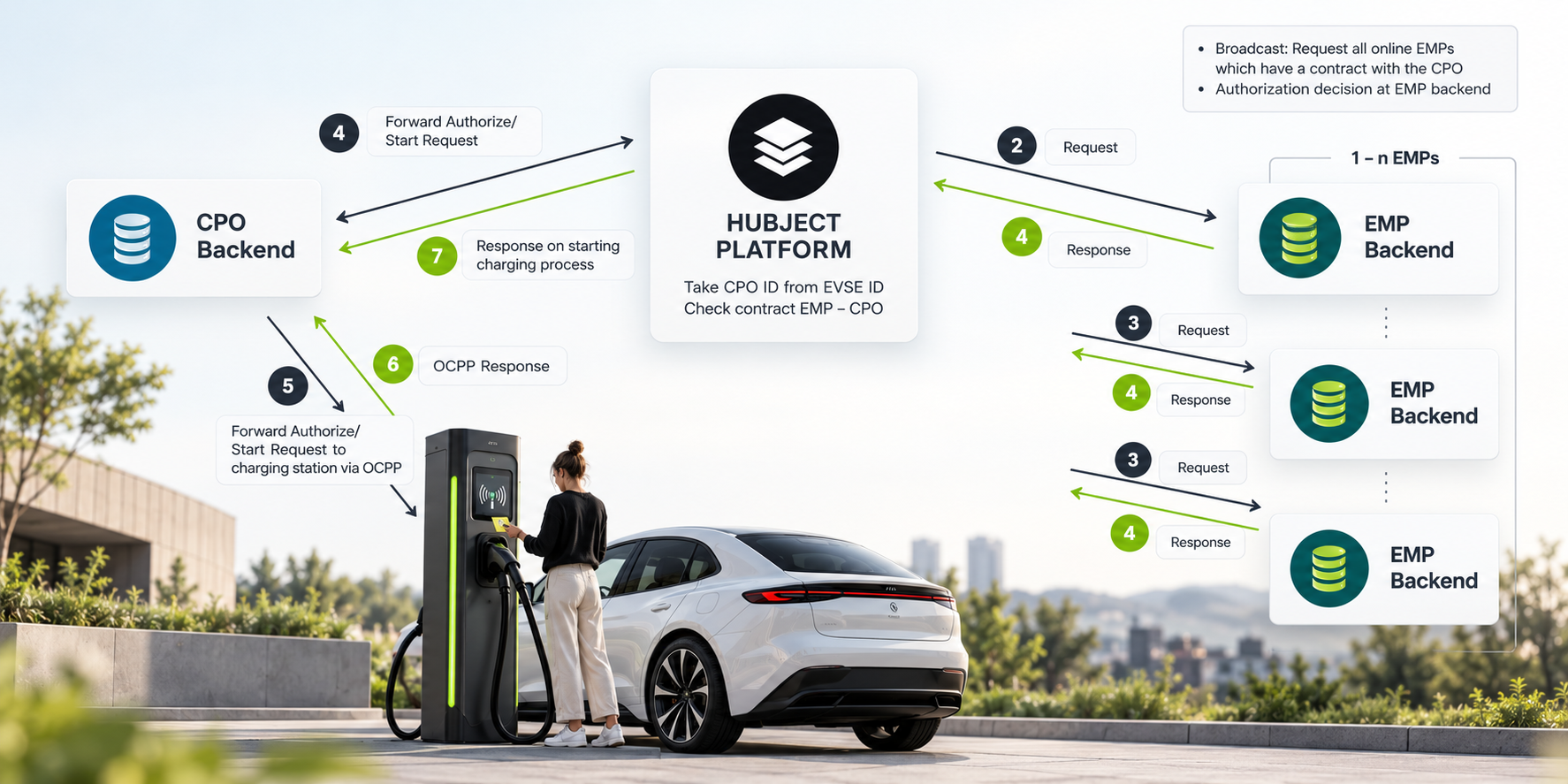
When it comes to API integration in the EV industry, one name stands out: Hubject. Hubject is a global platform that connects different stakeholders in the EV ecosystem, including charging network operators, e-mobility service providers and automotive manufacturers. Through its API integration solutions, Hubject is driving the future of EV roaming by enabling interoperability between different charging networks.
Hubject’s API integration allows EV drivers to access charging services across multiple networks using a single app or card. This eliminates the need to sign up for multiple accounts or carry multiple cards. Additionally, it enables real-time data exchange between charging network operators and service providers, ensuring accurate billing and reliable charging services.
OPEN INTERCHARGE PROTOCOL (OICP)
Hubject roaming is based on the Open InterCharge Protocol, documented openly on GitHub. Because the documentation is open source, anyone can download it for free and assess what changes their network needs before integrating through the API.
The impact of API integration on EV charging infrastructure
API integration is not only benefiting EV drivers but also having a significant impact on the overall EV charging infrastructure. By enabling interoperability between different charging networks, it promotes the growth of the charging infrastructure and encourages the adoption of EVs. Charging network operators can expand their reach and offer their services to a wider customer base, ultimately accelerating the transition to electromobility.
Moreover, API integration allows for the optimisation of charging infrastructure. By accessing real-time data on charging demand, network operators can better understand usage patterns and plan the deployment of charging stations accordingly. This helps to ensure that charging infrastructure is strategically located, reducing the likelihood of congestion and improving the overall efficiency of the charging network.
Improving the user experience through API integration
One of the key advantages of API integration in the EV industry is the ability to enhance the user experience. EV drivers no longer need to worry about the compatibility of their charging cards or apps with different networks. They can simply plug in and start charging, regardless of the network they are connected to.
What drivers get from API integration
- One account that works across charging networks
- Real-time information on station availability and status, so no trips to occupied or broken chargers
- Remote monitoring and control of charging sessions
- Charging abroad with the account they already have
It is important to remember that new industries do not develop overnight. Internal combustion cars have evolved over more than 100 years. It was time that made gas stations, three-point seat belts and airbags popular.
Now that time is what EVs need.
Leveraging API integration for seamless cross-border EV travel
API integration is not limited to national borders. It has the potential to transform cross-border EV travel by enabling seamless roaming across different countries. EV drivers can travel without the need for multiple charging cards or apps, and access charging services abroad using their existing account – just as we do with mobile phone roaming.
The future of API integration in the EV industry
API integration is still in its early stages in the EV industry, but its potential is immense. As the adoption of EVs continues to grow, the demand for seamless connectivity and interoperability will only increase. API integration will play a crucial role in expanding the charging infrastructure and ensuring a seamless charging experience for EV drivers.
PLAN INTEGRATION EARLY
Start this process as early as possible. Even at the stage of designing your own network or selecting a software provider, consider how it will integrate with other networks. Postponing it may make the integration difficult or even impossible.
It is one of the key software requirements we always discuss with our clients at i4B.
In the future, we can expect even more advanced API integration solutions, such as smart grid integration and demand response. These will further optimise charging, so that EVs are charged at the most cost-effective and energy-efficient times. API integration will also enable new services such as vehicle-to-grid, where EVs not only consume energy but also feed it back into the grid during peak demand.
Challenges and considerations of implementing API integration for EV roaming
While API integration offers many benefits, there are also challenges that need to be addressed.
Data security and privacy
With API integration, sensitive data such as personal and payment information is exchanged between different systems. Robust security measures are crucial to protect this data and build trust among EV drivers.
When building your own network or choosing a software provider, check that the technologies you use are up to date and run security audits to obtain security certifications. Data security and privacy are a priority here.
Standardisation of APIs
Currently, there is a lack of uniformity in API protocols and data formats across networks, which makes it challenging for different systems to communicate effectively. Industry-wide standards will be essential to ensure interoperability and avoid fragmentation of the EV charging ecosystem.
Establishing standards will take time and work by many organisations, but the foundation of a worldwide network of EV charging stations must be stable, proven and secure. Today’s online bank transfers, now the backbone of the economy, went through a similar process – banks and other institutions worked on them for years. In the same way, we are working today to integrate the various networks of EV charging stations.
Exploring other industries benefiting from API integration
API integration is not limited to the EV industry. In hospitality, it enables seamless booking and reservations across different platforms. In healthcare, it provides interoperability between different systems, improving patient care and data exchange.
In the near future, cars running on other fuels, such as hydrogen, are likely to become more common. The experience gained while building the infrastructure and networks for electric cars can be reused when building them for hydrogen cars.
It is not difficult to imagine a single app showing not only EV charging stations but also hydrogen refuelling points. And if hybrids running on both electricity and hydrogen arrive, one app that finds the right station regardless of fuel would be all the more convenient.
Conclusion
API integration is transforming the EV industry by enabling seamless connectivity and interoperability. EV drivers get a convenient, streamlined charging experience, while charging network operators can expand their reach and optimise their infrastructure. Hubject, one of the key players in EV roaming, is driving the future of electromobility by connecting different stakeholders in the EV ecosystem. As EV adoption grows, the role of API integration will only become more important.
Planning a Hubject or OCPI integration? See how i4B builds EV roaming software or talk to our team.